Most MVPs do not fail because they were too small. They fail because they were never small at all. They were a full product with a smaller budget and a shorter deadline, which is a different and much worse thing.
The shape is always the same. Somebody defines a minimum, everybody agrees, and then over eight weeks the scope reassembles itself from a series of individually reasonable additions. It has to have accounts. Obviously it needs an admin. We cannot launch without notifications. And by the time it ships, six months late, the thing that was supposed to test a hypothesis has become a small unmaintained product testing nothing.
The discipline that prevents this is not enthusiasm for cutting. It is having a rule for what stays.
What an MVP is actually for
It is not a small version of your product. It is an instrument for answering one question you cannot answer any other way.
That distinction decides everything. If you know what your question is, scope becomes obvious: anything that helps answer it stays, anything that does not, goes. If you do not know what your question is, every feature is arguably necessary and there is no principled way to cut anything.
So before scoping: write down the one thing you do not know and cannot find out without building something. Common versions:
Will anybody use this at all? The most common real question, and the one most often skipped because it is uncomfortable.
Will they pay? A different question, and much harder.
Can we deliver it profitably? An operations question that a product frequently exists to test.
Which of two approaches works better? Genuinely needs both built, at least partially.
If your answer is “several of those”, you are building more than one MVP and should sequence them.
The one question that decides scope
Having named your question, apply this to every proposed feature:
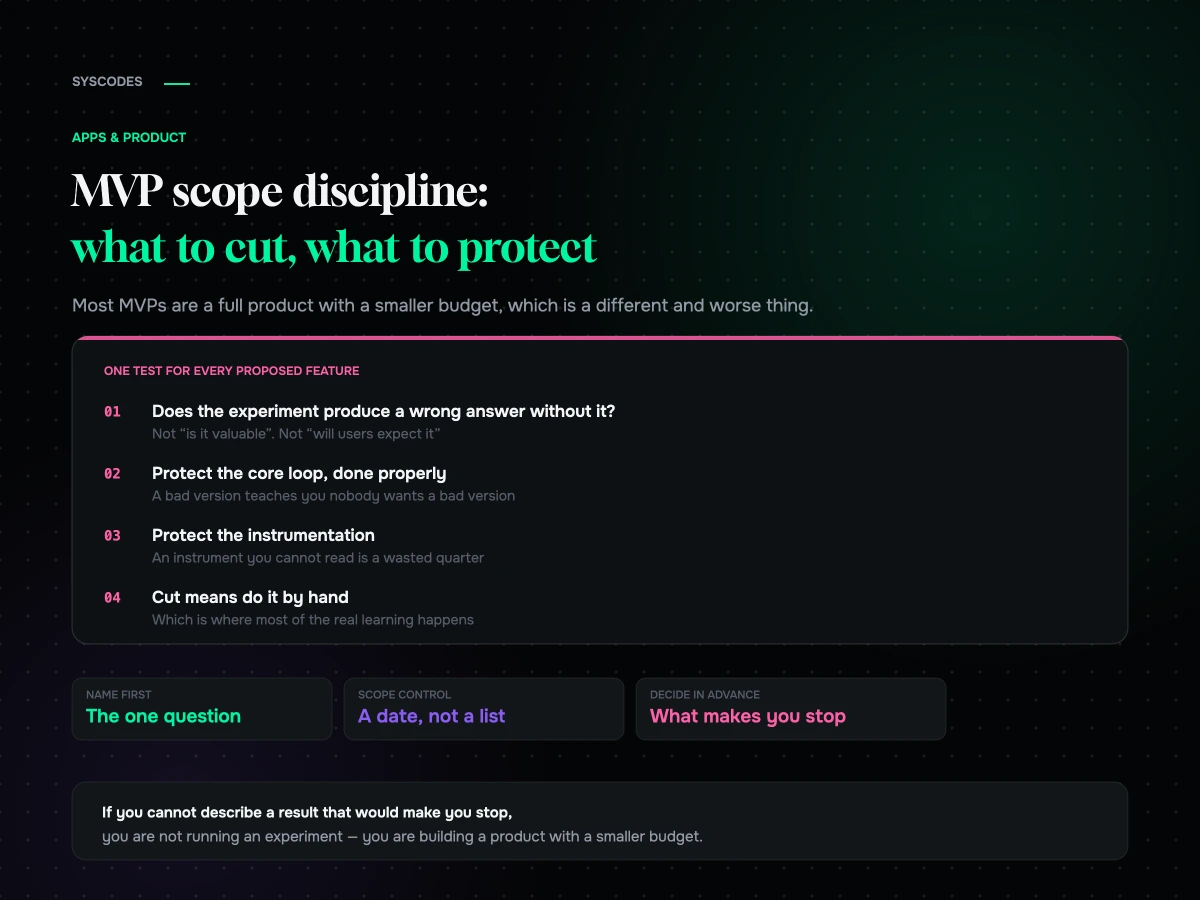
Does the experiment produce a wrong answer without it?
Not “is it valuable”. Not “will users expect it”. Not “is it easy”. Only whether its absence would make you draw the wrong conclusion.
Password reset does not change whether people find the core loop useful. It matters enormously in a real product and it does not change the answer to your question, so it can be a manual process for eight weeks.
An onboarding flow, on the other hand, might genuinely determine whether anybody ever reaches the core loop, in which case its absence produces a wrong answer, and it stays.
The test is uncomfortable to apply consistently, and applying it consistently is the whole skill.
Four categories of feature
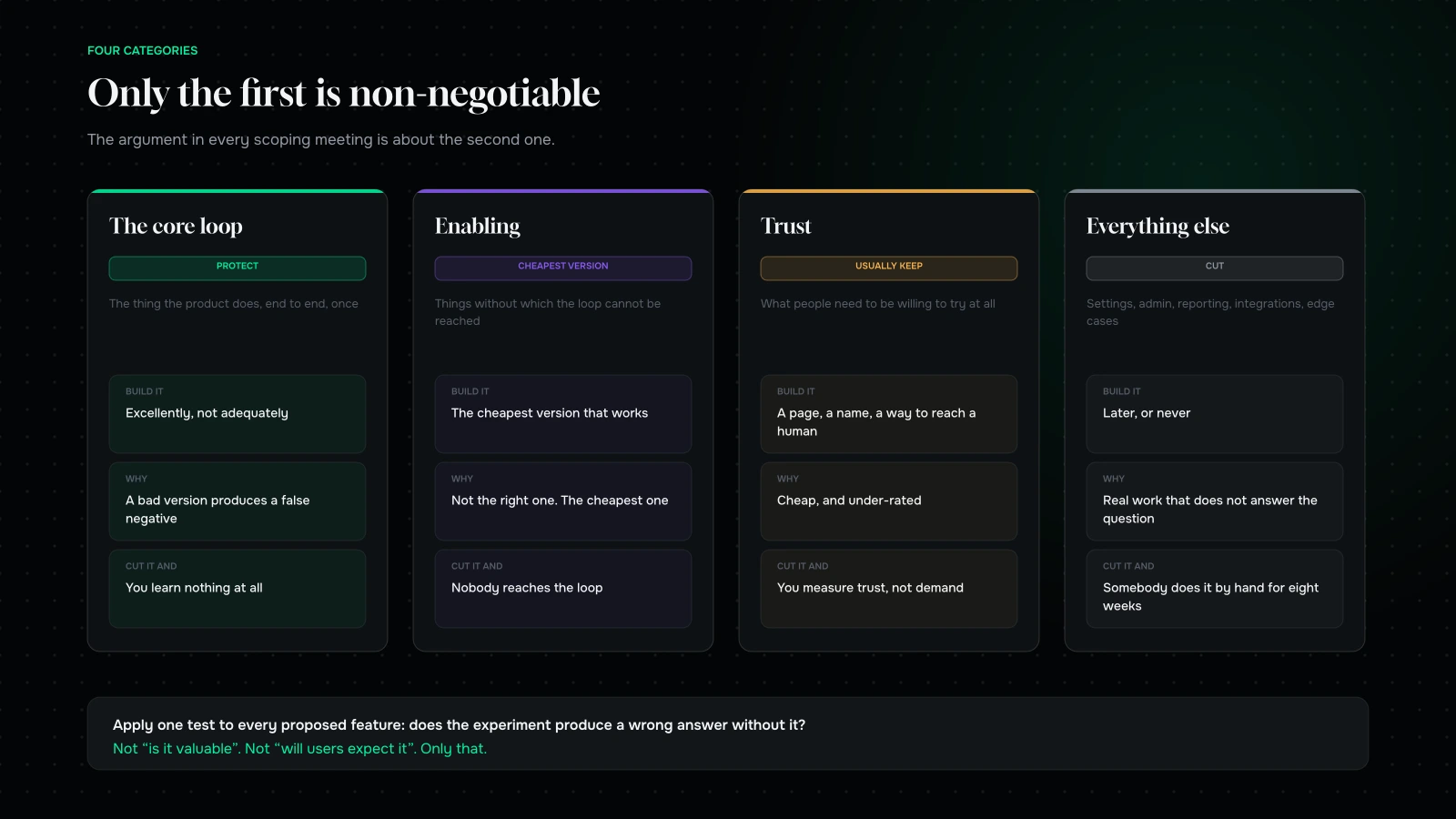
The core loop. The thing the product does, end to end, once. If somebody cannot complete it, you have learned nothing. This is non-negotiable and it should be excellent, not adequate: a bad version of the core loop produces a false negative, which is the most expensive result in the whole exercise.
Enabling features. Things without which the core loop cannot be reached: sign-in, some way to get data in, a way to see the result. Necessary, and the version you build should be the cheapest one that works. Not the right one. The cheapest one that works.
Trust features. Things people need in order to be willing to try: a privacy statement, a way to contact a human, an explanation of what happens to their data, and in some categories a credible-looking interface. Under-rated, and cheap. If your audience will not use it without them, they belong in the MVP.
Everything else. Settings, preferences, admin tooling, reporting, integrations, edge cases, the second use case. All of it is real work that will need doing eventually and none of it belongs in an instrument designed to answer one question.
The argument in every scoping meeting is about category two. The honest answer is usually: build the ugliest possible version.
What to protect, always
Four things, and cutting any of them is how MVPs produce false negatives.
The core loop, done properly. If the one thing your product does is slow, confusing or broken, you will conclude that nobody wants it, when what you have learned is that nobody wants a bad version of it. This is the single most common way an MVP lies to you.
Instrumentation. You are building an instrument. An instrument you cannot read is a waste of a quarter. Know before you start exactly which events answer your question, and make sure they are captured from day one.
A way to talk to users. The qualitative half is where the actual learning is. At small numbers, six conversations tell you more than any dashboard.
Enough polish to be credible in your category. In consumer products, a rough interface can be forgiven. In financial, medical or B2B contexts, it reads as untrustworthy, and you will have measured trust rather than demand.
What to cut, and what “cut” means
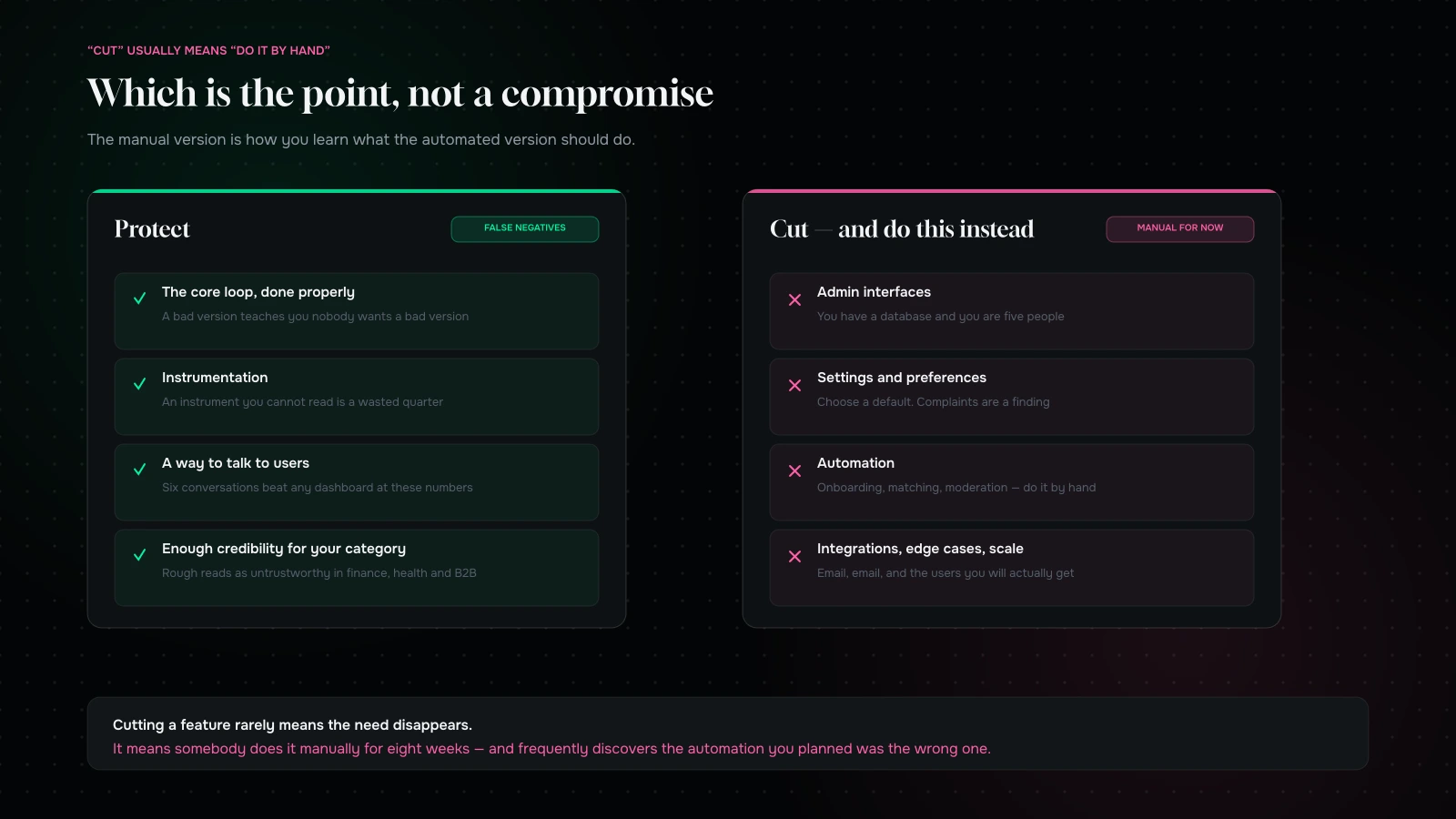
Admin interfaces. You have a database and you are five people. Use it.
Settings and preferences. Choose a default. If people complain, that is a finding.
Edge cases. Handle them by email. Every hour spent on the tenth-percentile path is an hour not spent on the core loop.
Automation of anything you can do by hand at your volume. Onboarding, provisioning, matching, moderation, sending the report. Doing it manually is faster to build, teaches you far more about the actual process, and frequently reveals that the automation you were about to build would have been the wrong automation.
Integrations. Unless one is the point of the experiment.
The second use case. Two audiences in an MVP means two experiments running simultaneously and no clean answer to either.
Scale. You do not need to handle a hundred thousand users. You need to handle the users you will actually get, which is a much smaller number and a much simpler architecture.
The important reframe: cutting a feature rarely means the need disappears. It means somebody does it manually for eight weeks. That is not a compromise. The manual version is how you learn what the automated version should do.
Fake it before you build it
Several questions do not need software at all, and answering them without building is the highest-leverage thing in this entire article.
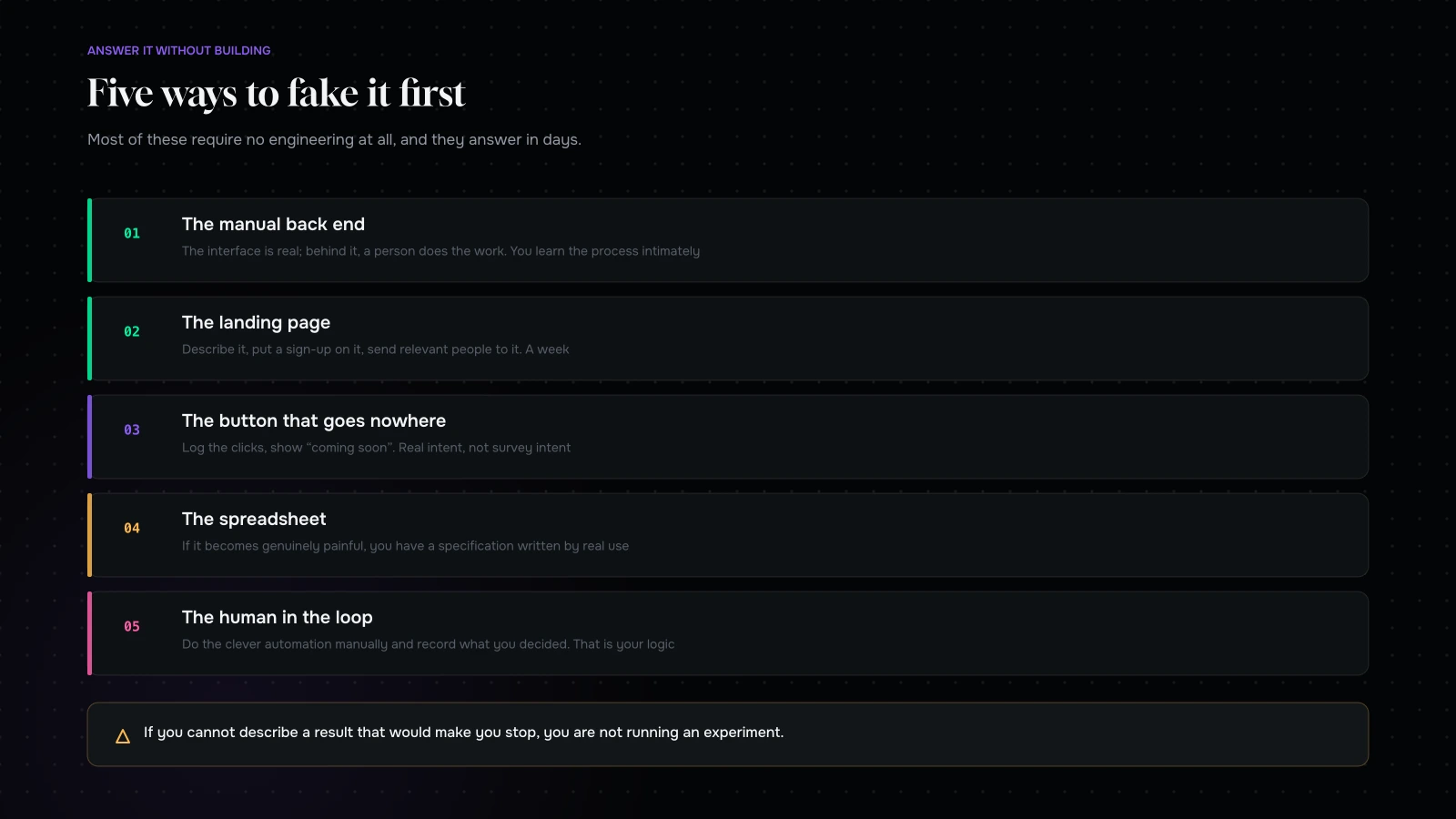
The manual back end. The interface is real; behind it, a person does the work. Users cannot tell, you learn the process intimately, and you build the right automation later, or discover that the serviceis the product and the software was never needed.
The landing page. Describe the thing, put a sign-up on it, spend a little money sending relevant people to it. It answers “does anybody want this” in a week.
The button that goes nowhere. Add the feature’s entry point to an existing product, log the clicks, show “coming soon”. Measures real intent rather than survey intent, which are very different quantities.
The spreadsheet. An enormous number of internal tools should be a spreadsheet for six months before they are software. If the spreadsheet becomes genuinely painful, you now have a specification written by real use.
The human in the loop. Anywhere you were planning to build clever automation, do it manually first and record what you actually decided. That record is your logic, derived rather than imagined.
The features that always come back
Six that reappear in every scoping conversation, with the version that is usually sufficient.
Accounts and authentication. Often necessary. Use something off the shelf and do not build password recovery flows by hand.
A dashboard. Almost never necessary in v1. People want the thing, not a summary of the thing.
Notifications. Usually replaceable with an email you send manually.
Search. Only if the dataset is large enough that browsing genuinely fails.
Permissions and roles. Only if your test group actually has different roles. Otherwise everybody is an admin.
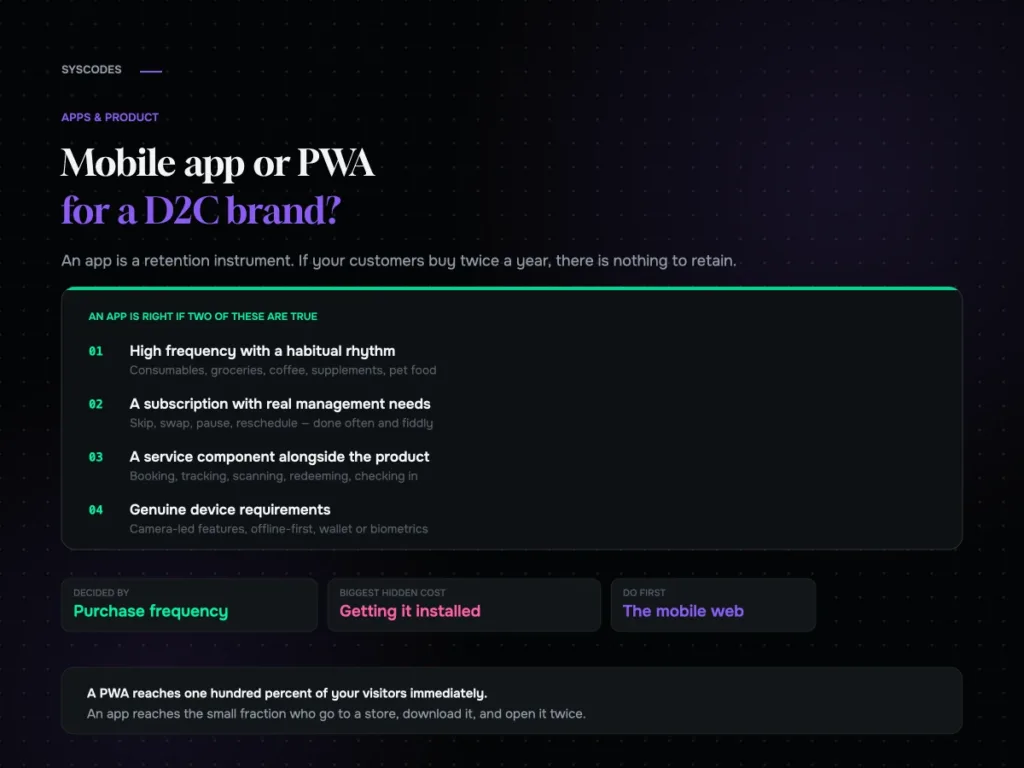
Mobile apps. Almost never in an MVP, for reasons we go through in mobile app or PWA.
Saying no without losing the room
Scope discipline is a social problem more than a technical one, and the technique matters.
Never say no. Say “not in this one”. Keep a visible list of everything cut, with the reason. People will accept almost any deferral if they can see their idea has been recorded rather than dismissed.
Attribute cuts to the question, not to your judgement. “That does not change the answer we are trying to get” is arguable on the merits. “I do not think we need it” is a fight about status.
Make the cost visible. Every addition has a date attached. If the launch moves by two weeks, say so out loud, every time. Most requests withdraw themselves when the trade is explicit.
Give the loudest stakeholder something. Frequently there is a cheap version of what they want. A manual process, a static page, a weekly email. Half a day buys a great deal of goodwill.
And set a date, not a feature list. Timeboxing is the only scope-control mechanism that reliably works, because the scope is the variable that flexes when the date does not.
A worked scoping example
Take a plausible product: a marketplace connecting independent workshops with people who want a repair.
The question. Not “can we build a marketplace”. It is: will people trust a stranger with a repair enough to book through a website rather than phoning somebody local? That is the thing nobody can answer without building.
What the core loop is. Somebody describes what needs fixing, sees who could do it, and books. End to end, once. If that does not work well, everything else is noise.
What survives the test. A way to describe the item, including photographs. A list of workshops with enough information to feel like a real choice. A booking action. Confirmation. Instrumentation on every step. And enough visual credibility that handing over a valuable object does not feel absurd.
What gets cut, and what happens instead. Payments: take them offline for now, or on a call. Workshop onboarding: do it by hand, over the phone, because that conversation is where you learn what workshops actually care about. Ratings: nobody has any yet, so the page can carry a sentence about how you vetted each one. Messaging: email. Scheduling: the workshop calls the customer. Admin: a spreadsheet.
What that leaves. Roughly a fifth of the original list, buildable in weeks rather than months, and it answers the question directly.
And the trap. The temptation is to build payments because “we will need it eventually”. You will. You do not need it to find out whether anybody trusts the model, and if the answer is no, you have saved the payments work entirely.
What to build in the eight weeks after
Assuming the answer was yes, the order matters as much as it did during the MVP.
First, whatever is currently breaking under manual effort. Not the most exciting thing, the thing your team is spending its evenings on. That is the automation the experiment specified for you, and it is now written from real use rather than imagination.
Second, the thing users asked for most in conversation, if it is consistent. Consistency matters more than volume; five people describing the same problem in similar words is a stronger signal than forty feature requests.
Third, the enabling features you deliberately faked, in order of how much friction they now cause.
And keep the list of everything you cut. Some of it is still not needed, and knowing which is worth more than the features themselves.
The pattern we see in the projects that go well: the second phase is smaller than people expect, because the experiment has ruled out a great deal. The projects that go badly build all of it anyway, which means the MVP never actually informed anything.
Timeboxing beats feature-boxing
Two ways to control an MVP, and only one of them works.
Feature-boxing fixes the list and lets the date move. It feels responsible and it fails predictably, because every discovery during the build becomes an argument for extending the date, and there is no natural point at which somebody says stop. Six weeks becomes five months, one reasonable extension at a time.
Timeboxing fixes the date and lets the list move. It works because it forces the prioritisation conversation continuously rather than once at the start, when you knew least. Eight weeks is eight weeks; what ships is whatever survived the weekly triage.
The objection is that timeboxing means shipping something incomplete. That is correct and it is the point: an MVP is incomplete by design, and the risk you are managing is not incompleteness. It is spending a year on an instrument that never gets read.
Two practical rules that make timeboxing work. First, protect the core loop from the timebox: if the loop is not going to be good, move the date once, deliberately, and say so. Second, review scope weekly against the question rather than against the plan, and cut in public.
Who should be in the room
Scope discipline is mostly about who has authority, and MVPs go wrong when that is diffuse.
One person owns the question. Not the product, the question. They decide whether a feature changes the answer, and their decision is final in the moment. Anything else and every scoping decision becomes a negotiation.
One person owns the date. Frequently the same person, and it does not have to be.
Whoever will do the manual work should be in the scoping meeting. They are the person who will onboard by hand and moderate by hand for eight weeks, and their view on what is actually sustainable is the most grounded input available.
Whoever will talk to users should be there too, because the qualitative half needs designing at the same time as the build, not afterwards.
And the person who will pay for phase two. If they have not agreed what result means what, the experiment produces an answer that nobody acts on, which is the most common wayan MVP is wasted even when it worked.
Everyone else can review. If more than five people can add scope, you do not have an MVP.
Where this connects to the rest of the build
Two practical notes for teams doing this alongside an existing business.
If the MVP touches your storefront (a new purchase flow, a configurator, a subscription), resist building it inside the store. Build it beside the store, as a small application that hands off, exactly as we argue in Shopify Plus versus a custom build. It keeps the experiment reversible, which is most of its value.
And if the question you are testing is really about demand rather than product, a landing page and two weeks of traffic will answer it faster than any build: the same logic that applies to going direct before you have an audience. Build the software when you have run out of cheaper ways to be wrong.
Reading the result
The last discipline, and the one most often skipped: decide in advance what result means what.
Before you launch, write down what would count as a yes, what would count as a no, and what you would do in each case. If you cannot describe a result that would make you stop, you are not running an experiment. You are building a product with a smaller budget, and the MVP framing is doing no work.
Then be honest about what a weak result means. Sometimes it is “nobody wants this”. Sometimes it is “the version we built was not good enough to tell”, which is what happens when the core loop was cut down alongside everything else. The way to tell them apart is the qualitative half: talk to the people who did not come back, and listen for whether they did not want it or could not use it.
What it comes down to
An MVP is an instrument for answering one question. Name the question, and every scope decision follows from it: does the experiment produce a wrong answer without this?
Protect the core loop, the instrumentation, the conversations with users, and enough credibility for your category. Cut admin, settings, edge cases, integrations and automation, and be clear that cutting means doing it by hand, which is where most of the real learning happens.
Then set a date, keep a visible list of everything you deferred, and decide in advance what result would make you stop. That last one is what separates a real experiment from an expensive way to build a product slowly.
Scoping one now? Send us the question you are trying to answer through the contact form and we will tell you which parts of your list change the answer and which are a manual process for eight weeks. We would rather build you a smaller thing that tells you something.
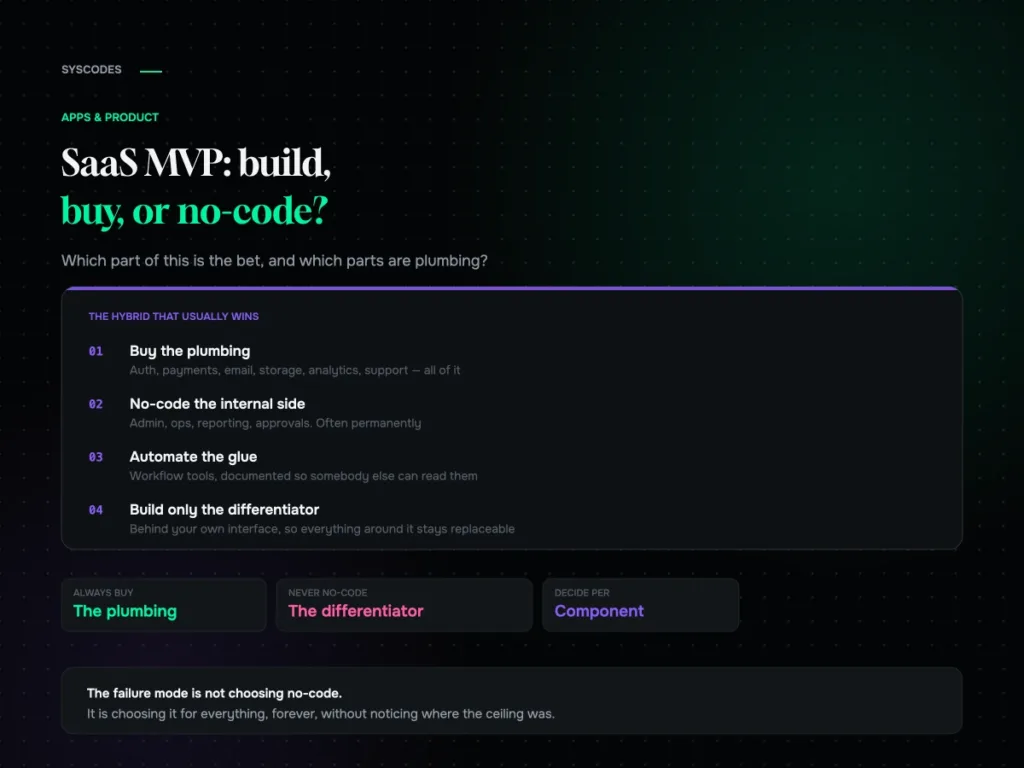
You can also read SaaS MVP: build, buy or no-code, or mobile app or PWA for a D2C brand.

Written by
Founder, Syscodes
Founder and CEO of Syscodes Infosystems Pvt. Ltd., the Kolkata studio he started in 2020. He writes about platform choices, migrations, conversion research and MVP scoping.