Shopify does a great deal of the expensive work for you. Hosting, security, payments, checkout, certificates and platform updates are all handled, and none of them appear on your invoice as engineering.
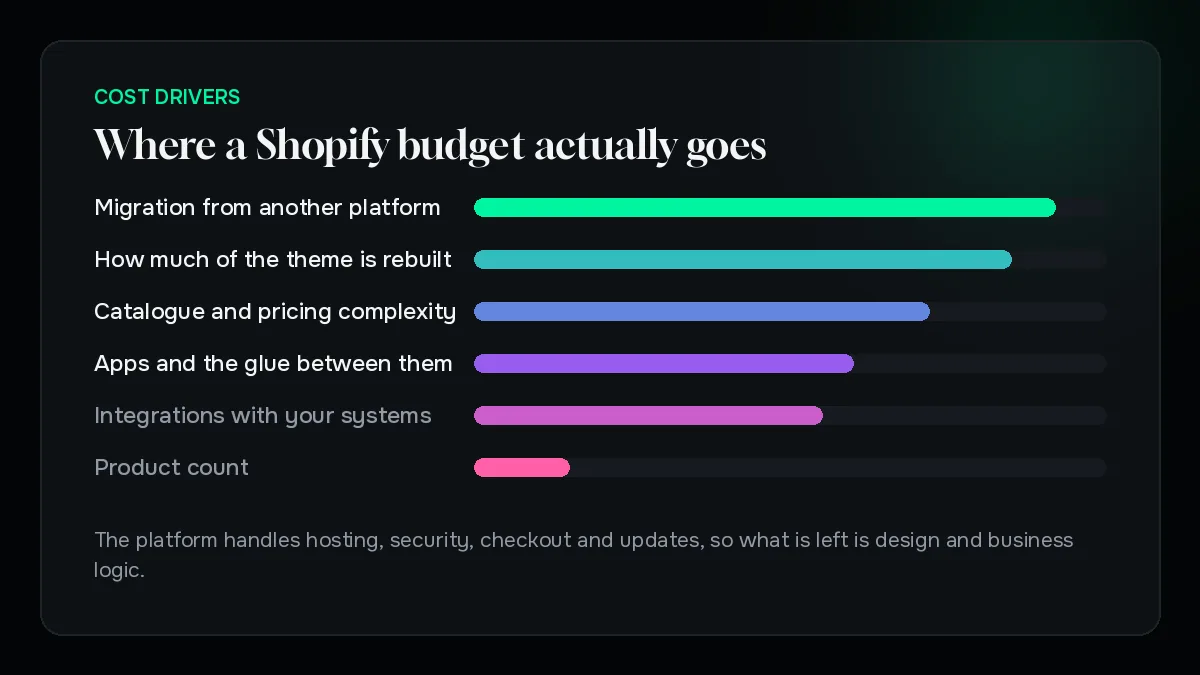
That is exactly why Shopify quotes still vary so widely. With the platform costs removed, what remains is almost entirely design and business logic — the two things most sensitive to how your brand actually sells.
This piece covers what a Shopify website costs to build in terms of scope rather than price: how much of the theme is being rebuilt, how many apps you are committing to, what has to be migrated, and what the store costs to run once it is live. No figures here, as with our other cost pieces. The same brief can be answered three defensible ways, and the useful conversation is about which one you need.
Three routes, and how to tell them apart
Nearly all Shopify cost variation reduces to which of these you are buying.
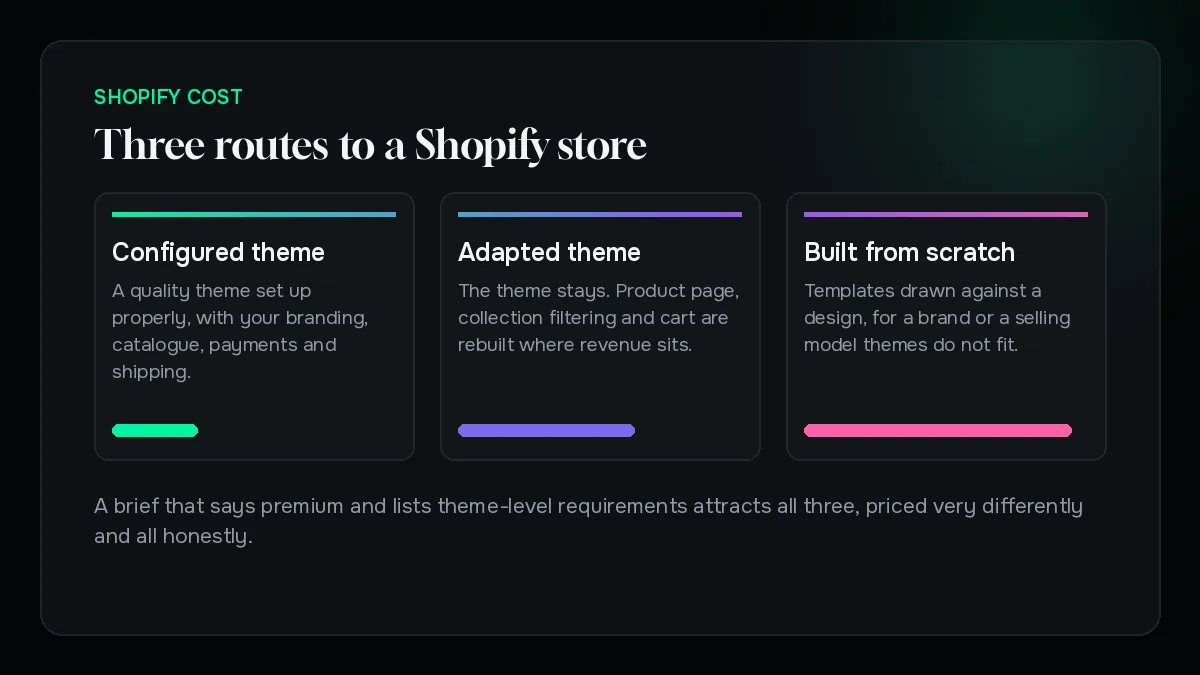
A configured theme. A quality theme set up properly, with your branding, catalogue, payments and shipping. Done well this is a genuinely good store, and for a first launch it is very often the right decision.
An adapted theme. The theme stays, but the templates that carry revenue are rebuilt: product page, collection and filtering, cart. Sections are built so your team can compose new pages without help.
A theme from scratch. Built against a design, usually because the brand needs a distinctive experience or the selling model does not fit what themes assume.
A brief that says premium and lists theme-level requirements will attract all three, priced very differently and all honestly.
What is actually on the invoice
With the platform handled, a Shopify quote has fewer lines than a comparable custom build — but they should still be visible.
Discovery. Catalogue structure, variants, shipping and tax rules, and what happens after an order.
Design. Templates and a section library, or theme configuration.
Theme work. Liquid, sections, and any custom logic.
Apps. Selection, configuration, and any glue between them.
Data. Products, variants, images, customers and order history.
Testing. Real orders, including failures and refunds, on real devices.
Launch. Domain, redirects, tracking, and the first week of watching.
If a quote is a single figure, ask for it split this way. The split is where you learn whether data and testing were actually costed or quietly assumed.
The apps question, and the bill you do not see
Apps are the most underestimated part of running a Shopify store, because they move cost from the build to the monthly bill.
They accumulate. Reviews, subscriptions, loyalty, bundles, upsells, search, page building, back-in-stock alerts. Each solves a real problem and each renews every month, and few merchants audit the list once it exists.
They interact. Several apps injecting scripts into the same theme is the most common cause of a slow Shopify store, and of the bugs that appear only at checkout.
Some are worth replacing with theme code. If an app does something small and charges monthly forever, building it into the theme can pay for itself inside a year and remove a dependency at the same time.
Ask for the intended app list with the quote, with the monthly total. A cheap build with an expensive stack is a common and avoidable outcome.
Where Shopify genuinely resists you
Shopify is opinionated, and knowing where the edges are prevents expensive surprises.
Checkout. Heavily controlled by the platform. What can be customised depends on your plan, and assuming otherwise is a costly assumption to discover late.
Complex pricing. Customer-specific pricing, quantity breaks and trade accounts are all achievable, but they are app or plan territory rather than theme work.
Deep catalogue logic. Configurable products and large variant matrices strain what the platform models natively.
None of these are reasons to avoid Shopify. They are the questions worth asking early, because the answer sometimes changes the platform decision, and it is far cheaper to change it before the build than during.
Migration is the biggest variable
Moving an existing store is usually the largest single item in a Shopify project.
What moves. Products and variants, images, customers, order history, reviews, content pages, and the URLs currently earning traffic.
What is awkward. Subscription arrangements, loyalty balances, and discount logic that was built into the previous platform.
What protects revenue. The redirect map. WooCommerce, Magento and WordPress all structure URLs differently from Shopify, and Shopify imposes its own patterns you cannot fully override.
If a replatform quote does not discuss redirects in detail, that is the first thing to raise. It is the one part of a migration where a mistake is immediately visible in the numbers.
Design: where custom work actually pays
The temptation on Shopify is to redesign everything, because themes make it feel inexpensive. Most of that spend does not return.
Where it pays. The product page, the collection and filtering experience, and the cart. Those three carry nearly all of the revenue effect, and small improvements there compound across every session.
Where it rarely does. Policy pages, the about page, and the blog. Themes handle them competently and customers do not judge you on them.
The part that compounds. A section library. Build one and your team composes new landing pages without a developer for years. Skip it and every campaign page is a small job.
If the budget is tight, spend it on those three templates and the section library, and leave the rest to the theme.
Plus, and when it is actually the answer
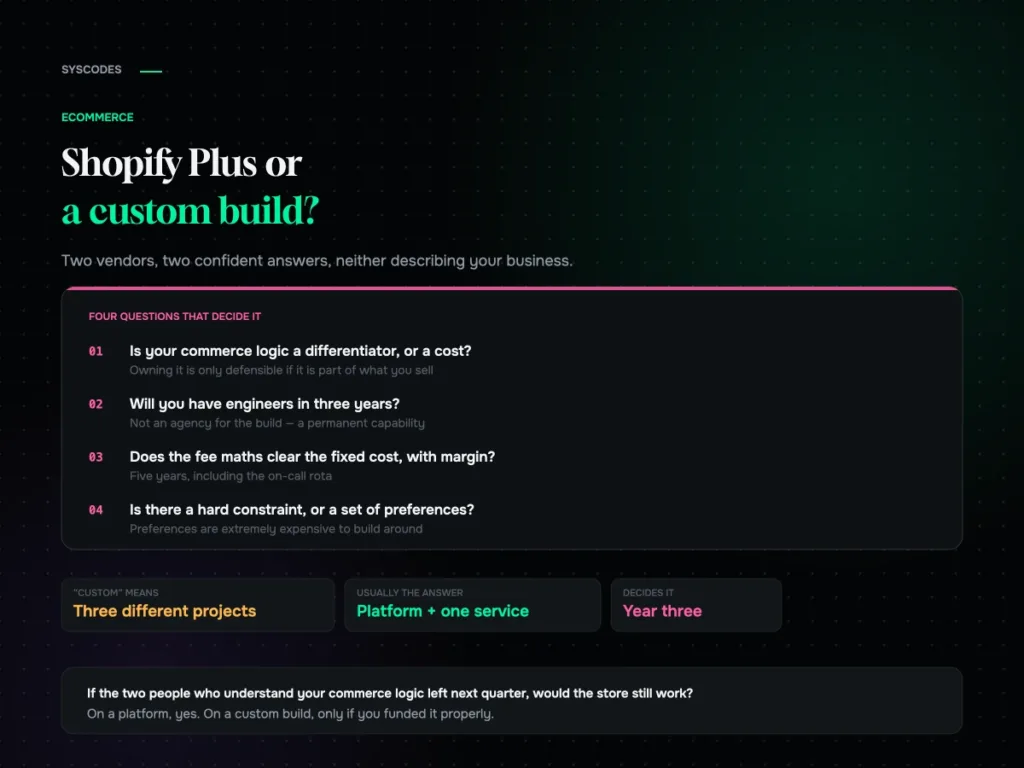
Shopify Plus is a genuine step up and a genuine step in cost, and the reasons to move are narrower than the sales conversation suggests.
Real reasons. Checkout customisation you cannot get otherwise, multiple storefronts across regions or brands, wholesale alongside retail, high order volume, or automation across your operations.
Not reasons on their own. Wanting the store to feel premium, or being told the current plan is limiting without anyone naming the limit.
The useful test is whether you can name the specific capability you need and confirm it is only available on Plus. If you can, the case is usually clear. If nobody can name it, you are being sold a plan rather than a solution to a problem you have.
What it costs to run
The build is a one-off. The store is a monthly commitment, and it is worth seeing the whole picture before comparing quotes.
The platform subscription. Predictable and easy to plan for.
Transaction and gateway fees. Which vary with the payment provider you choose.
Apps. The line that grows quietly, as above.
Maintenance and improvement. Theme updates, app conflicts, and the changes that follow real customer behaviour.
A store that is never touched after launch does not stay level. Apps update, themes fall behind, and the small frictions that cost you orders are never found. Plan for continuous small work rather than a large rebuild every few years.
How to brief so quotes are comparable
Four things settle most of the variation.
Say which route you want. Configured, adapted, or from scratch.
Describe the catalogue honestly. Variant complexity and any pricing that changes by customer or quantity.
Name your apps and integrations. Current and intended, including accounting, courier and ERP.
Say whether this is a migration. If so, from what platform, how many products, and how much order history matters to you.
Those four turn three incomparable quotes into three comparable ones, which is worth more than any negotiation.
Five questions that separate a good quote from a cheap one
What is not included? Still the most revealing question available to you.
Which apps, and what is the monthly total? Ask before signing, not at the first invoice.
Who loads the products and writes the copy? The most commonly disputed line in any store build.
What happens to our existing URLs? Essential on any replatform.
Is the theme in version control, and do we get it? A theme you cannot take to another developer is a commercial arrangement, not an asset.
What it comes down to
Shopify build cost is decided by four things: whether the theme is adapted or drawn from a blank page, how complex your catalogue and pricing are, what has to be migrated, and how many apps the store depends on.
The platform itself removes most of the rest, which is the main reason to choose it. What remains is design and business logic, and those are worth scoping carefully rather than pricing quickly.
If you have a quote in hand, or you are weighing an adapted theme against a build from scratch, send it over. We will tell you which route the quote actually describes and what we would ask before committing to a number.

Written by
Founder, Syscodes
Founder and CEO of Syscodes Infosystems Pvt. Ltd., the Kolkata studio he started in 2020. He writes about platform choices, migrations, conversion research and MVP scoping.